

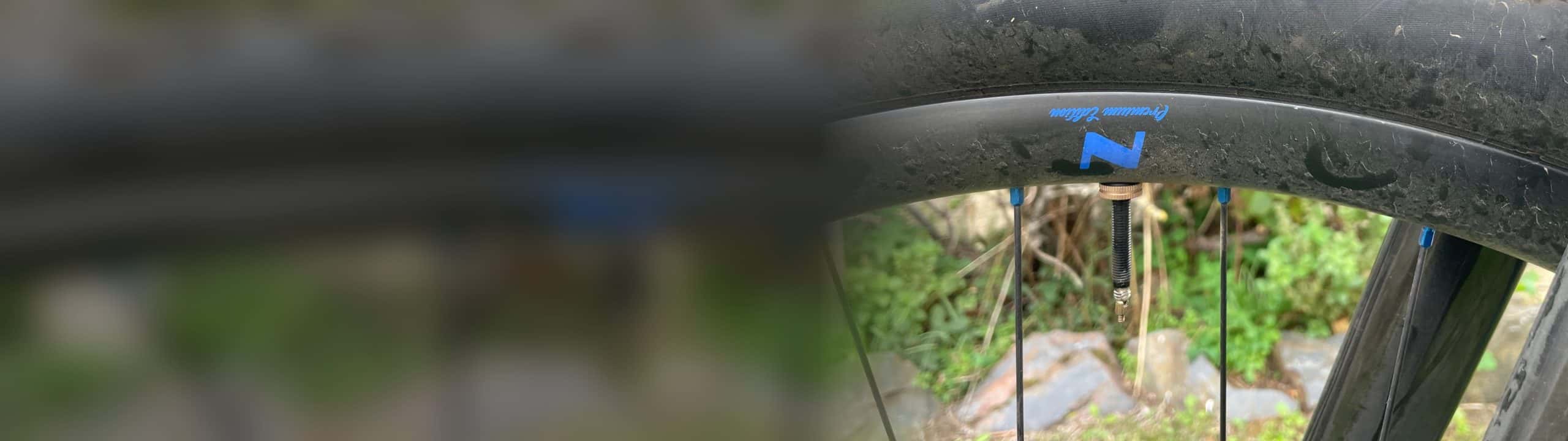
Why tyre pressure matters
Tyre pressure is the cheapest change you can make to how a bike feels. Too high and the tyre bounces off small bumps instead of rolling over them, so you go slower on roads and trails, lose grip in corners and arrive more tired. Too low and the tyre squirms, the rim can hit the ground, and with an inner tube you risk a pinch flat. The best pressure sits between the two, and it depends on more than most charts admit.
How this calculator works
It starts from a well-known rule: for the same amount of tyre squash under load, the pressure you need rises with the weight on the wheel and falls as the tyre gets wider, though not in direct proportion. Wider tyres carry the same weight on a lower pressure. It then adjusts for the surface, tubeless or tubes, casing, rim width and how you want the bike to ride, and splits your weight between the front and rear wheels in the way that suits each type of bike. Treat the answer as a good starting point, then fine-tune it.
Tubeless or inner tubes
Tubeless tyres have no tube to pinch, so they can run around 8 to 10 per cent lower than the same tyre with a tube. That extra give smooths rough surfaces and adds grip without adding drag. If you ride tubes, the calculator raises the number to keep pinch flats at bay. If you are not sure whether to switch, our workshop videos cover setting up tubeless.
Rim width
The inside width of the rim shapes the tyre. A wider rim spreads the tyre out, gives it a broader base and more air volume, and lets it work at a slightly lower pressure. On road and gravel wheels that is about 2 to 3 per cent per millimetre. Pick one of our Nextie rims in the calculator and it fills in the width for you. Always check that your tyre is approved for the rim, using the tyre maker's chart.
Hookless rims and pressure limits
Hookless rims have no lip to hold the bead, so they rely on lower pressures. Road and gravel hookless rims are usually limited to about 5 bar (72.5 psi), and mountain bike hookless rims to about 2 bar (30 psi). Tick the hookless box and the calculator caps the answer and shows a warning. It does not replace the maximum on your rim and tyre, so read both, and never exceed the lower of the two.
How to fine-tune your pressure
Ride your usual loop at the calculated pressure. Then drop 1 to 2 psi at a time until the tyre feels vague or squirms in corners, and go back up one step. That is your pressure. If you feel every bump, or the rim strikes on hits, add a little. Change one thing at a time, note the numbers, and use the "Copy my numbers" button to keep them.
Typical pressures by discipline
These are rough starting points for an 80 kg rider, bike and kit, tubeless. Your own result will differ.
- Road, 25 to 30 mm: about 55 to 75 psi (3.8 to 5.2 bar).
- Gravel, 35 to 45 mm: about 28 to 42 psi (1.9 to 2.9 bar).
- Mountain bike, 2.25 to 2.5 in: about 18 to 26 psi (1.2 to 1.8 bar).
- Fat bike, 4.0 in: about 5 to 10 psi (0.3 to 0.7 bar), lower on snow and sand.
- E-bike: a few psi higher than the same tyre on a normal bike, to carry the extra weight.
Need a wheel to suit?
I hand-build carbon wheels in Rochford and can match the rim width to your tyres. Book a wheel build or see the Nextie rims we can build with.