

Frames 1.07
Axles and dropouts
Hub widths and axles have changed a lot, and a wheel that looks right can be a few millimetres out. This is a straightforward guide to help lift the mystery: what the numbers mean, how to measure your frame, and what has to match.
Get the printable PDFThree ways to hold a wheel
Quick release
A thin skewer through a hollow axle, clamped in open dropouts. Older road and mountain bikes.
Thru-axle
A thick axle that screws into a closed dropout. Stiffer, and the wheel always goes back in the same place.
Bolt-on
A solid axle held with nuts. Singlespeeds, hub gears and older bikes.
Which one have I got?
- Check your bike's original spec. Look up your model and year on the maker's website. Look for a line like "12x148 Boost".
- Look at the axle. A thin skewer with a lever is a quick release. A thick axle that screws in is a thru-axle.
- Read the end of a thru-axle. Many have their length and thread printed on them, like M12x1.5 and 174.
- Measure inside the dropouts with the wheel out, from one inner face to the other. That's the hub width the frame takes.
Rear hubs
| Hub width (mm) | Axle | You'll often find it on |
|---|---|---|
| 130 | Quick release | Road bikes with rim brakes |
| 135 | Quick release | Older mountain bikes, disc road and touring |
| 142 | 12 mm thru-axle | Disc road, gravel, some older mountain bikes |
| 148 (Boost) | 12 mm thru-axle | Most modern mountain bikes |
| 157 | 12 mm thru-axle | Downhill bikes |
| 170 / 177 | Quick release / 12 mm thru | Fat bikes, 4" tyres |
| 190 / 197 | Quick release / 12 mm thru | Fat bikes, 5" tyres |
Front hubs
| Hub width (mm) | Axle |
|---|---|
| 100 | Quick release, 12 or 15 mm thru |
| 110 (Boost) | 12, 15 or 20 mm thru |
| 135 | Fat bike, quick release |
| 142 | Fat bike, 15 mm thru |
Tools
- Tape measure or callipers
- Allen key to fit your axle
- Torque wrench
Things that catch people out
- Boost isn't just 6 mm wider. A 142 hub won't simply go in a 148 frame. Everything on a Boost hub sits further out.
- Thru-axles come in different lengths and threads. Buy one to suit the frame, not the hub.
- A quick release axle is longer than the hub. About 11 mm longer than the hub width, so it sits in the dropouts.
- Front Boost is 110, not 100. A Boost fork needs a Boost front hub.
- Some hubs can be converted. Many hubs swap end caps between quick release and thru-axle. Check with the hub maker first.
From the workshop
Before you order a spare thru-axle, read what's printed on the end of your old one and take a photo. If there's nothing on it, bring the bike in and we'll measure the frame and match it.
Michael
Book it inThru-axles in the shop
See them all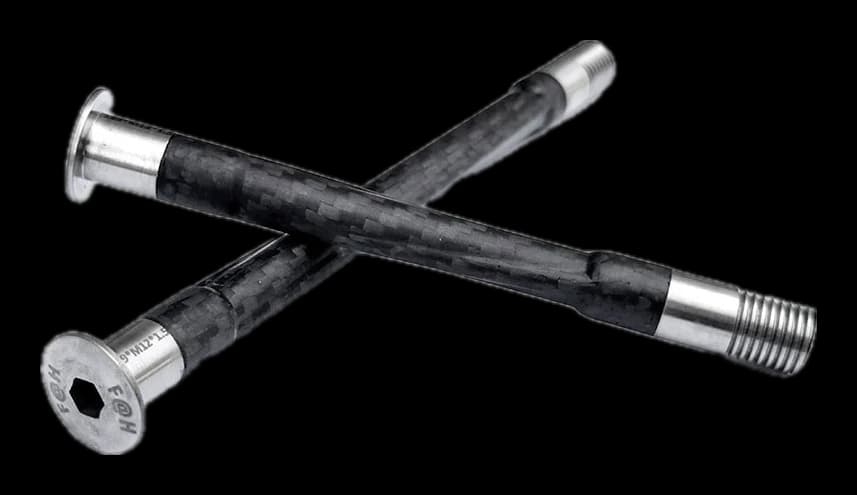
Not sure which fits? Send us your bike's make, model and year and we'll tell you.
Get the printable PDF
The same guide on two A4 pages, to print for the workshop or keep on your phone. Leave your email and we'll send the link. It unlocks every guide in the library on that device.
Already unlocked on this device? Download the PDF
This guide is general advice for home mechanics. Bikes and parts vary, so always follow the maker's instructions and torque settings for your parts. If you're not sure, or the job needs tools you don't have, ask a qualified mechanic. Travers Bikes can't be responsible for work you carry out yourself. Nothing here affects your legal rights. Sizes checked 16/11/2026 against Sheldon Brown's frame spacing list and Wheels Manufacturing.